Audiences of news sources vary dramatically in their levels of education, finds Pew Research Center survey
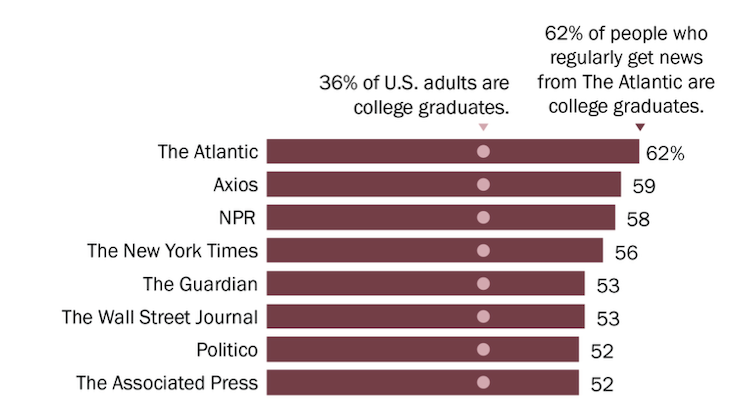
The American audiences of 30 prominent news sources vary dramatically in their levels of education, according to a Pew Research Center survey. (The top eight are shown above and the full list is below.)
The following is Pew’s report on their survey’s results:
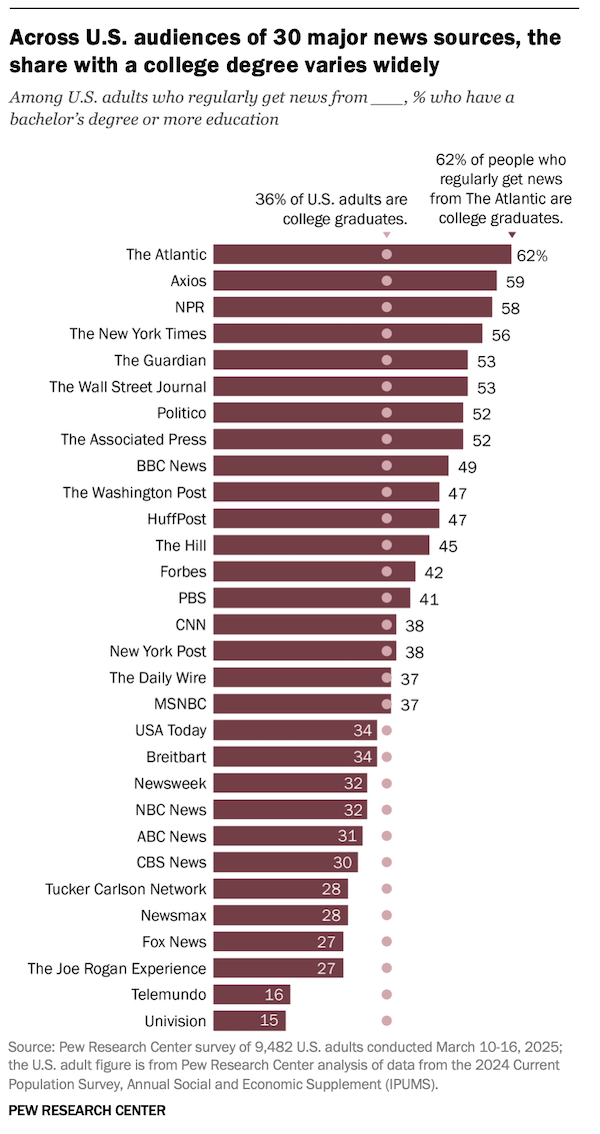
Roughly six-in-ten U.S. adults (62%) who say they regularly get news from The Atlantic have at least a bachelor’s degree. Axios, NPR and The New York Times also have audiences with relatively high levels of formal education: More than half of adults who regularly get news from these outlets have a college degree. Overall, 36% of all U.S. adults are college graduates.
By comparison, Univision and Telemundo – the two major Spanish-language TV networks included in our survey – have the lowest percentages of college graduates in their audiences at 15% and 16%, respectively. Most Americans who regularly get news from these outlets are Hispanic, and Hispanic adults in the United States are less likely to have a college degree than U.S. adults overall (20% vs. 36%).
When it comes to major broadcast TV networks, about three-in-ten U.S. adults who regularly get news from NBC News (32%), ABC News (31%) and CBS News (30%) are college graduates. This is just below the national level of U.S. adults with bachelor’s degrees. These three networks are all among Americans’ most common sources of news, according to our survey.
CNN and Fox News also rank among the nation’s most popular news sources. CNN’s audience has a similar percentage of college graduates (38%) as U.S. adults overall, while Fox News has a somewhat lower share (27%).
A few other news sources with predominantly Republican audiences – including the Tucker Carlson Network, Newsmax and The Joe Rogan Experience – have similar shares of regular news consumers who are college graduates as Fox News.
Republican voters are generally less likely than Democratic voters to have a college degree. But these differences in audiences’ educational levels aren’t just the result of partisan preferences for different outlets. Even within each party, the audiences of various news sources have widely different levels of educational attainment. For example, Republicans who regularly get news from The Wall Street Journal are much more likely to have a college degree than Republicans who regularly get news from CBS News.