
Where’s AI taking us? (Part 2)
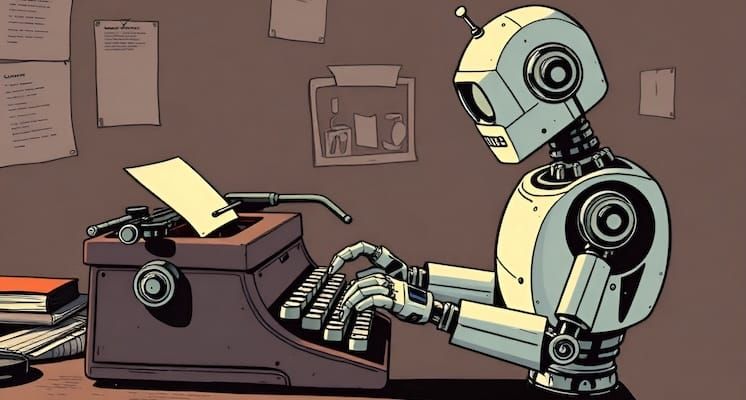
This is the second of a two-part post about where AI is taking us.
You can read the first part here.
Words: What Are They Good For in the Age of AI?
Usability researcher have determined that most visitors to a website typically read about 20-28% of the text on the page where they land. This probably isn’t news to you: it’s been a well-established fact for a long time that people just don’t read much of what we communicators put in front of them. That’s why formatting is so important. Eye-tracking studies show that people tend to read in a “F”-shaped pattern online, starting by scanning the first paragraph, scanning across the next paragraph or so, and vertically scanning the left side of the page. This scanning behavior means that elements like headlines, subheads, and bullet points are essential if you hope to get your point across because that’s pretty much all that people are going to read. And while much of this research has been done using websites, it’s a pretty safe bet to assume that the same patterns hold for print.
And yet many of us still keep cranking out the text, filling page after page with text even when we know that most of it is not going to be read except by search engine bots seeking to index and rank the pages we create. And while search engine optimization is vitally important to get your brand seen by people who might be interested in what you’re selling, once you entice them there all that content you’ve created, fought over, and lovingly tweaked to the most exacting brand standards is mostly ignored by the visitor who spends on the average about 15 seconds scanning your content before moving on.
But if you’ve ever tried to argue that there’s too much text on website’s pages, chances are you haven’t made much headway paring the content down to the bare essentials. Surely your customers and prospects need all the detail on those pages. That’s what differentiates you from your competitors! That’s the nuance and detail that tell the story of your brand! It’s all really important stuff!
Oh, yeah…and you’ve got a bunch of expensive “content creators” led by even pricier “content strategists” lovingly crafting all those words.
Words that nobody’s reading.
If you’re looking to see how artificial intelligence is going to disrupt the practice of communication today and into the future, it’s here: the utilitarian text that, like it or not, read by customers or not, we’re all forced to create to provide the heft and the gravitas and the SEO-fodder that fills up so many websites.
Up until now we had to hire human copywriters to generate content to fill the hungry maws of our websites. In fact, most web design/re-design projects lived or died on our ability to crank out the content necessary to fill those pages, and, as you know if you’ve ever gone through the joys of redesigning your organizations website, they ain’t easy to fill in a timely manner because it takes time to write all that text and gather the images — even if they’re stock images — to fill the voids.
But now? With the tools we have available to all of us right now, at a cost that pretty much any organization large or small could afford and far cheaper than any freelancer you could hire, all this utilitarian text can be generated more or less instantly. With one catch: to do anyone any good, it’ll need to be guided by someone who knows what they’re doing and then most likely edited for brand-adherence and readability. People are still going to be in the loop, but there will be far fewer people slinging content than in the pre-AI days. AI’s going to make it very clear what we really value when it comes to what humans can do.
Back to the Future
While the future is far from set in stone, the past still serves as an example we can look to as we navigate these still-early days of the AI revolution. What’s going on with AI today is very much like what happened when desktop publishing replaced the old paste-up and layout methods that had come before. Prior to desktop publishing technology, creating a printed page required a whole crew of people, afterwards anyone with a Mac and a laser printer could create passable publications by themselves.
I am (barely) too young to have lived through that revolution, but I’ll never forget getting a tour of my first agency and being hustled past a big empty room filled with strange equipment. “What’s that?” I asked, too naive to understand why the old timer showing me around frowned when I posed the question. “Oh yeah…that…print production area…let’s move on,” he muttered as he hustled me past the dusty space.
Where is AI going to take us?
I can’t tell you exactly, but I’m pretty certain that the future will include new dusty spaces to fill.